After four years, the Edo-Tokyo Museum in Sumida is alive again. On April 25, 2026, one of Japan's most beloved cultural institutions throws open its newly renovated doors with a special exhibition that could not be more fitting for the occasion: In Praise of Great Edo, a sweeping, lovingly curated tribute to the city that became the beating heart of a nation.
Held in the museum's first-floor special exhibition room through May 24, the show draws entirely from the institution's own vast collection of approximately 350,000 items, a deliberate and confident choice that signals both the depth of the museum's holdings and its renewed ambition. Around 160 works have been selected, including a number of pieces never before displayed to the public.
A Plain, a Poem, and the Birth of a City
The exhibition opens not with castle walls or samurai armour, but with grass and moonlight. The broad plain that would one day become Tokyo was long known as Musashino, an uta makura, a place name charged with poetic resonance, celebrated in Japanese verse since the Nara period. An anonymous folk song captured its essence: "The plains of Musashino have no mountains for the moon to set behind; it rises from the grasses and sets within them." Widely known throughout the Edo period, these lines inspired countless works of art and established the enduring image of a vast, moonslit wilderness.
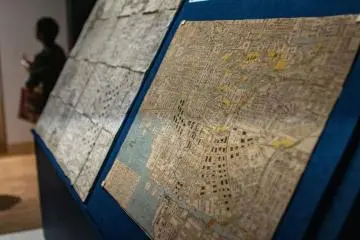
It was into this landscape that the Edo clan first moved in the late Heian period, lending the area its name. In 1457, the warlord Ōta Dōkan built the first Edo Castle, and the region grew into a significant hub of commerce and traffic. Tokugawa Ieyasu took possession of the castle in 1590, and what followed was one of history's great urban transformations. The exhibition's opening Musashino-zu Byōbu, a folding screen from the mid-Edo period, conjures the emptiness that preceded it all, setting up, with quiet poetry, the magnitude of what would come.
A Warrior City That Learned to Dance
When Tokugawa Ieyasu formally established his shogunate in 1603, Edo became the political centre of the nation almost overnight. Samurai flooded in: the shogun's direct vassals, daimyo lords from across Japan, their retainers and household staff. Residences for warrior families spread in rows around Edo Castle, and a city unlike any other began to take shape. It was a grand, martial place, early daimyo residences adorned with gold-leaf tiles referenced the dazzling Azuchi-Momoyama style, but it was also a city learning, slowly, to put down its weapons.
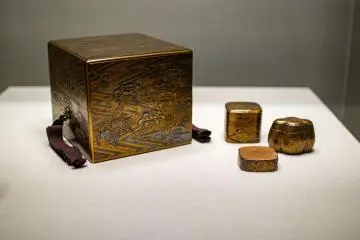
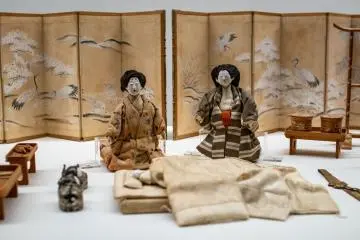
The great Meireki fire of 1657 burned down much of Edo, including the castle itself. The keep was never rebuilt, a deliberate symbol, many historians argue, of a world at peace. Armour and bladed weapons, displayed here in extraordinary examples by the celebrated Myōchin school of armourers, had long since ceased to be instruments of war. They had become emblems of lineage and authority, deployed in ceremony rather than on the battlefield. Bridal trousseau sets, lacquered, gilded and exquisite, announced the rank of noble households with theatrical flair. Two standout suits of armour by master Myōchin Muneyasu and his disciple Myōchin Munechika, dated 1844 and 1856, hang in riveting dialogue: iron and silk cord as the language of status.
The Pleasure City
By the start of the eighteenth century, Edo's population had surpassed one million (roughly half samurai, half commoners) making it one of the largest cities in the world. As merchants and artisans accumulated wealth and cultural confidence, they transformed the city from within. A great variety of entertainments and customs spread from the warrior class to the townspeople, and Edo became, in every sense, a pleasure city.
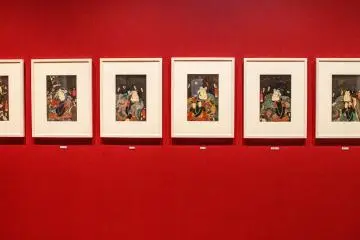
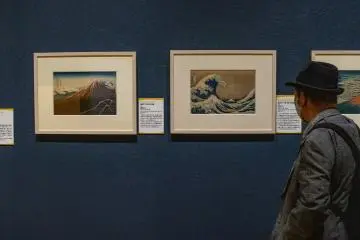
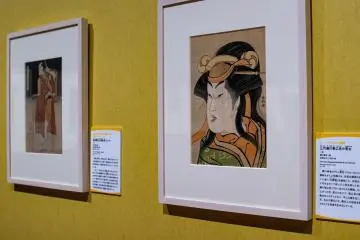
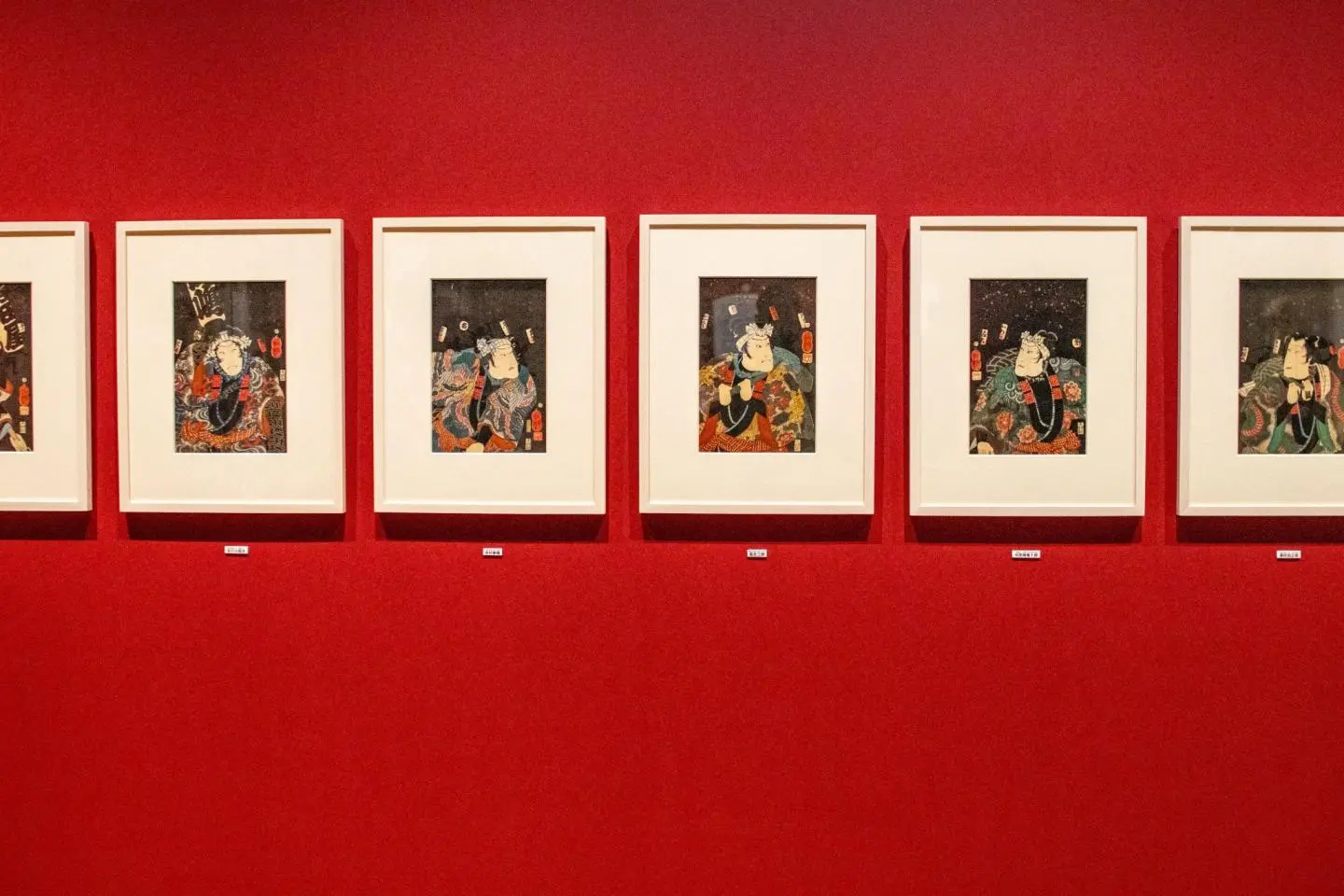
The second chapter of the exhibition is where things crackle with energy. The celebrated chronicle Edo Hanjōki names its three great pillars: sumo wrestling, kabuki theatre and the Yoshiwara pleasure quarter. Ukiyo-e woodblock prints bring this world to vivid life, such as brawny wrestlers locked in contest, kabuki actors caught in moments of theatrical intensity, courtesans of the Yoshiwara rendered with meticulous elegance. Works by Utamaro, Sharaku and Utagawa Toyokuni feature alongside lesser-known masters, weaving together a portrait of a city utterly in love with its own spectacle. These nishiki-e polychrome prints did not merely reflect the fashions of the day; they created them.
Fire, Heroism and the Spirit of Edo
No account of the city would be complete without fire. Packed with wooden structures and swept by dry winter winds, Edo was chronically vulnerable to catastrophic blazes. "Fires and fistfights are the flowers of Edo », the phrase was less a lament than a declaration of civic identity. Two distinct firefighting forces emerged: the samurai brigades, responsible for the castle and warrior districts, and the townsmen's brigades, who protected the commoner quarters.
The exhibition's third chapter brings this world to life through richly embroidered fire-fighting robes, helmets and tools of extraordinary craftsmanship. Firefighters worked by preventative destruction and their courage was matched by their pride. Disputes between rival brigades were common and fierce; a fire was where honour was at stake. The chapter's displays make it plain that in Edo, even disaster was an occasion for culture.
Kindred Spirits: Intellectuals, Eccentrics and Bestsellers
The final chapter turns inward, into the salons and studios of Edo's cultural elite. In the latter half of the eighteenth century, as the city's culture matured, a new kind of figure emerged: the scholar-artist-eccentric, whose talents cut across social boundaries. The shogunal vassal Ōta Nanpo led the craze for kyōka satirical verse. The low-ranking samurai Hiraga Gennai became a restless polymath, driven by curiosity about Western knowledge and technology. The painter Sakai Hōitsu, born to a daimyo family, founded the Edo Rimpa school, fusing Kyoto refinement with downtown Edo spirit. And the novelist Kyokutei Bakin spent twenty-eight years writing his monumental Nansō Satomi Hakkenden, a bestseller that captivated commoners across the city.
Their handwritten letters, displayed here alongside published works and collaborative projects, trace the networks of friendship and rivalry that gave Edo its intellectual vitality. These were not solitary geniuses but nodes in a wide, complex web of cultured people — officials, publishers, painters and poets — for whom Edo itself was the great enabler.
In Praise of Great Edo closes with the concept that gives the city its nickname. The honorific Ō-Edo, "Great Edo", emerged in the latter eighteenth century as the city outgrew both Kyoto and Osaka in size and influence. Its residents coined a word for themselves: Edokko, "Edo natives." They were proud, opinionated and fiercely attached to their city, a city of samurai who became aesthetes, merchants who became patrons, and citizens who turned even catastrophe into culture.
The museum's own return, after four years of renovation, feels, in this light, entirely apt. Edo's story was always one of perpetual reinvention.